Two updates for anyone waiting on a B-khata to A-khata conversion in Bengaluru. The road blocker has a fix on the way. The fee discount does not — not yet.
The short version
- If your A-khata is stuck on the road, there is now a fix. Two bills passed the Assembly on 21 August that let your city corporation take over the private road your layout was built on.
- It works without the builder's consent, and without paying him a rupee — because he already collected the value of that road when he sold the plots facing it.
- It is not law yet. The Legislative Council and the Governor still have to sign off, and nothing has changed at the counter until they do.
- This only helps if the road was your blocker. Unpaid tax, a court case, or farm land never converted on paper are separate problems, and this does not touch them.
- On the fee: the 2% window closed on 23 August and was not extended. The rate is back to 5% of guidance value. We think another window is likely, but nothing has been announced.
First — what is a khata, exactly?
Your khata is the municipal record that says this property is yours and you are the one who pays tax on it. There are two kinds.
- A-khata — everything is in order. Banks lend on it, you can get building plan approval, and it sells easily.
- B-khata — you are on the register, but something is pending. Most banks won't lend, you cannot get plan approval, and it sells harder and at a discount.
Getting from B to A is what everyone in these layouts is trying to do. About 8.5 lakh properties in Bengaluru are sitting on a B-khata right now.
The problem: a road with no owner
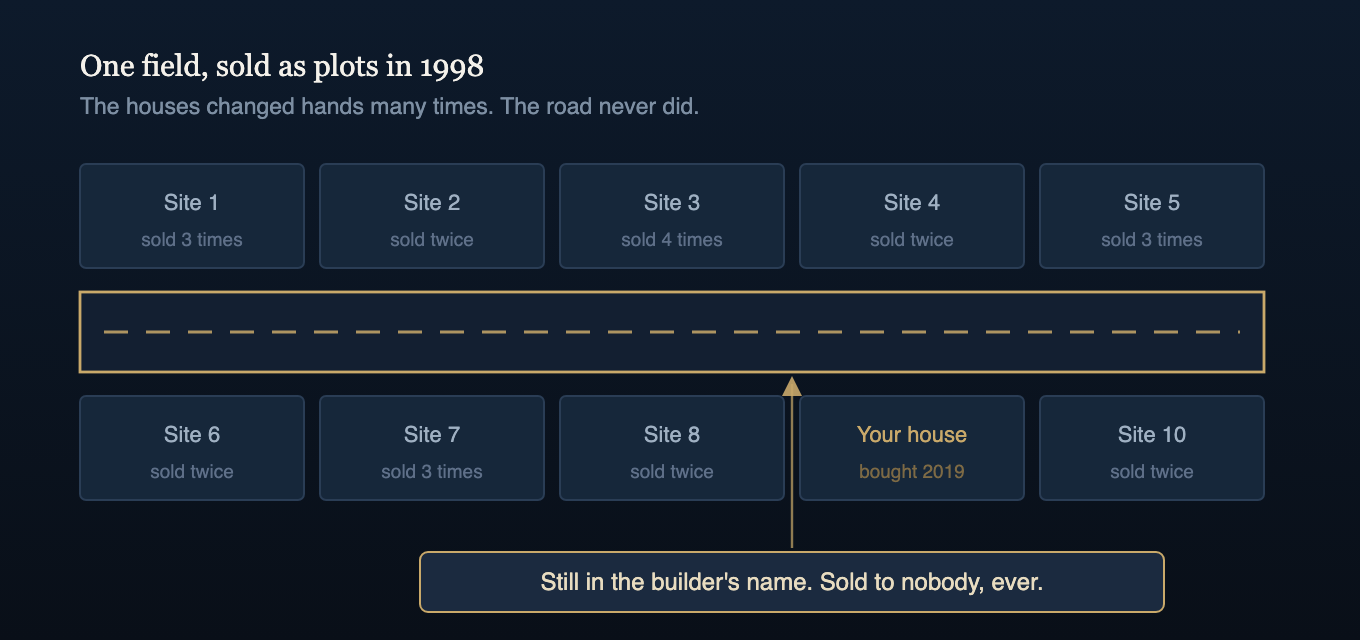 The plots moved. The road didn't.
A B-khata can be caused by several things, and the road is only one of them. But it is one of the most common in Bengaluru's older layouts — and the one an owner has almost no way of fixing alone. Here is why.
Picture how your layout was actually built.
Someone owned a field. He drew plots on it, drew a road down the middle, and sold the plots one by one. People built houses. Over thirty years those houses were sold, inherited, and sold again.
The road was never sold to anyone. It is still sitting in the name of the man who drew it — someone who may have died, moved away, or vanished long ago.
So nobody maintains it, because nobody owns it. And the application makes your road a formal question you have to answer. The BBMP-GBA form has a section headed "Road fronting the single plot details", with two fields: the road type, and the nearest public road, chosen from the corporation's own list. It also asks separately whether your plot is a corner site opening onto two or more roads, and the boundary schedule wants to know what sits on each side of you. Your road is not a detail in this process. It is one of the things being checked.
If you have been told your application is "pending road verification", this is what that means. Talk to our khata experts →
What just changed
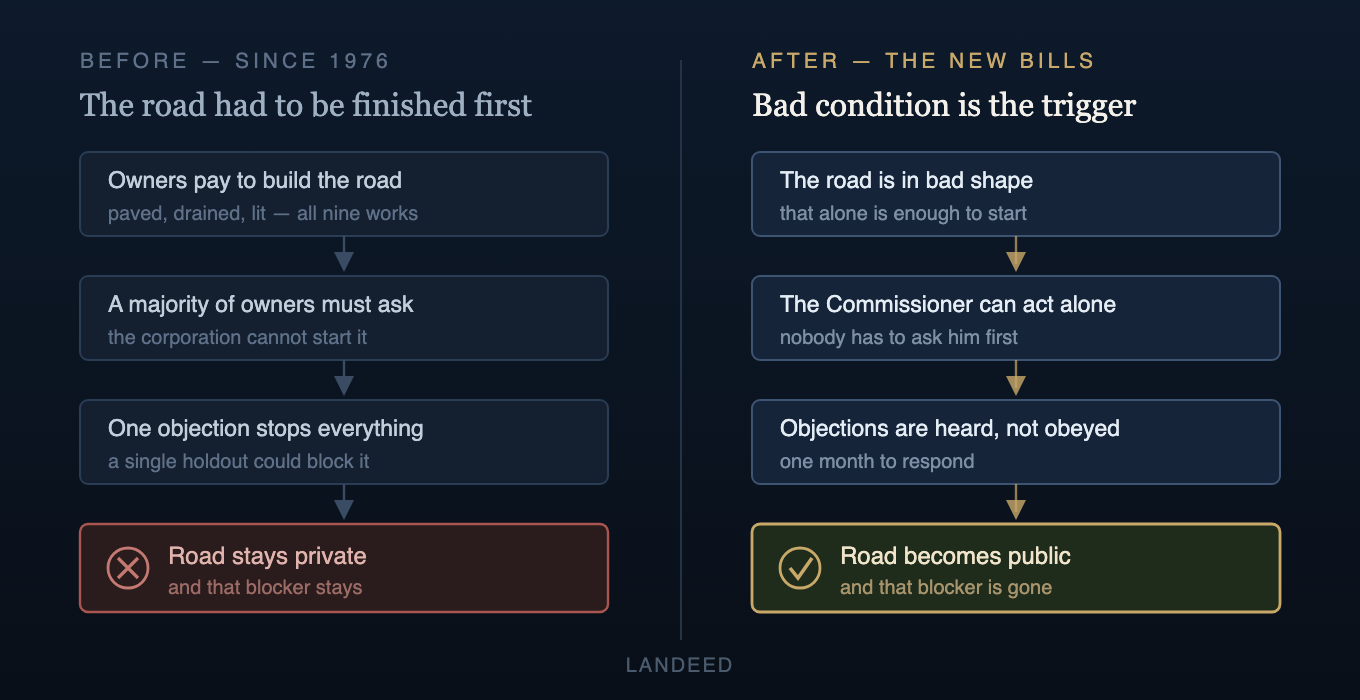
The old law, written in 1976, said the corporation could take over your road only after it was fully built — paved, drained, lit, the lot. The owners had to pay for all of that themselves first. Then a majority of them had to formally ask. And if even one owner objected, it stopped.
In a layout the builder walked away from, that never happened. Which is exactly why these roads stayed orphaned for forty years.
The new law says the opposite. If the road is in bad condition, the Commissioner can take it over — on his own, without anyone asking him.
That is the whole change. One sentence in an old Act, turned around.
Does this apply to you?
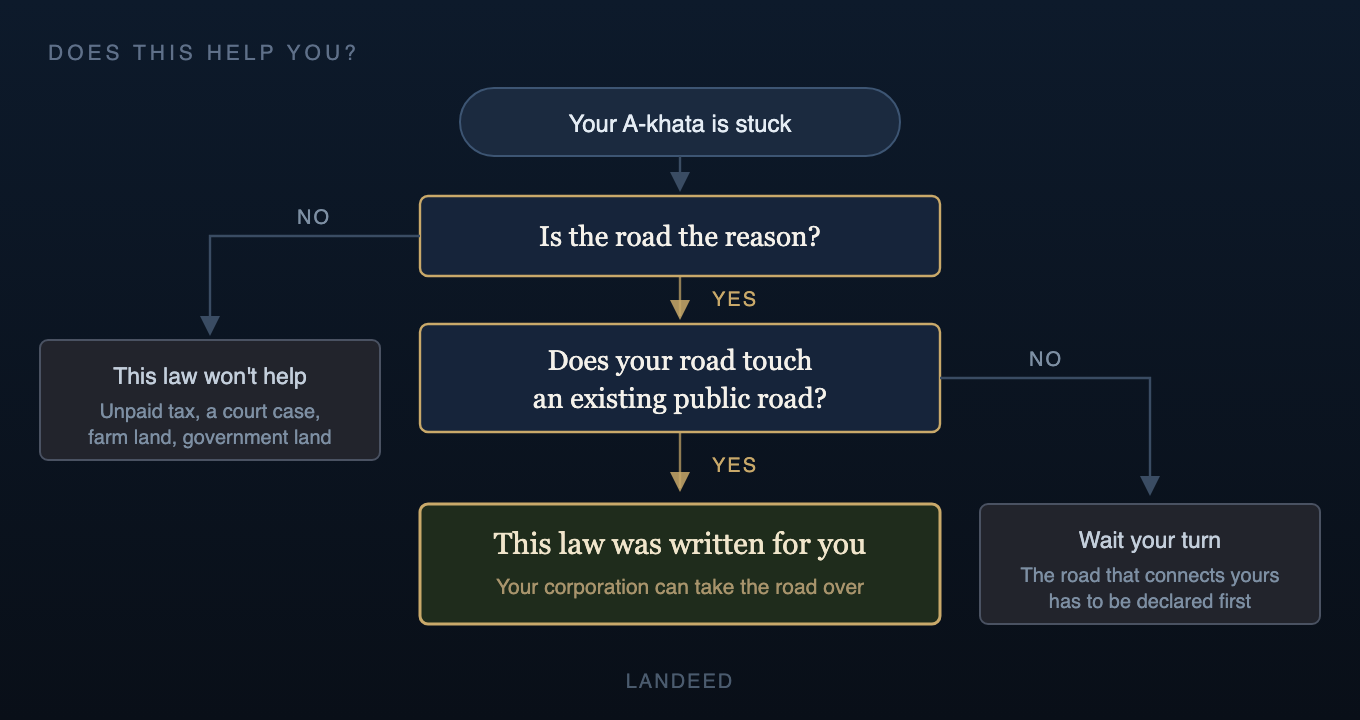
The straight answer: this helps if the road was the thing blocking you.
If something else is also wrong — unpaid property tax, a court case, farm land that was never converted on paper, or a site on a lake bed or government land — this law does not touch any of that. You would need to fix that first.
Three things worth knowing
- Your road has to be in bad shape. That is written into the law as the trigger — the street and its drains must be in "such a poor condition that endangers public safety and health". If your layout association has been maintaining a decent road at its own cost for years, the wording is an awkward fit. How corporations apply it in practice will matter.
- Your road has to touch a public road. If your layout is reached only through another private road, that one has to be declared public first. Expect this to work outward from the main road inward, not all at once.
- Your neighbour can object, but cannot block you. Objections can be filed within one month of the public notice. The Commissioner has to consider them — but under the new wording, an objection no longer stops the declaration. Under the old law for smaller towns, one holdout could.
A side note, since people ask: the builder cannot demand to be paid for the road. If he showed it in the registered sale deed and sold the plots facing it, he gets no compensation and no Development Rights Certificate — and neither do his heirs. He already collected its value when he sold those plots.
What this law does not do
Worth being straight about, because the headlines have run ahead of the documents.
Neither bill mentions the word "khata" anywhere. We read both texts in full. "Khata", "layout", "unauthorised" and "regularisation" do not appear once. What was passed is a road law, nothing more.
That does not make the khata link false — it makes it indirect. Road status is one of the things the khata process checks. Change the road, and a property failing on that one point can now pass it. But you still apply the normal way, through the normal portal, and you still have to clear everything else.
This law removes a blocker. It does not hand anyone an A-khata.
Where it stands today
- Introduced in the Assembly — 19 August 2026
- Passed by the Legislative Assembly — 21 August 2026
- Passed by the Legislative Council — not yet
- Governor's assent — not yet
Source: the Assembly's own bill list for this session, where the Council and assent columns are still blank. The session runs to 27 August 2026, so the Council may take it up before it rises.
Until it gets assent, nothing has changed at the counter. Anyone offering to file under the new road rule today is ahead of the law.
The two bills, if you want to read them: Karnataka Municipal Corporations (Amendment) Bill, 2026 for city corporations including Bengaluru's five, and Karnataka Municipalities (Amendment) Bill, 2026 for the rest of Karnataka.
What about the fee?
The 60% discount — conversion at 2% of guidance value instead of 5% — ended on 23 August 2026, and the rate is back to 5% for now.
If your application went in by 23 August, you are still on 2%. The portal's own notice is explicit that it is the submission date that counts, not the approval date: applications submitted on or before 23.08.2026 pay 2% even if they are approved months later. That matters, because field verification alone can run to 45 days — a slow case does not cost you the discount.
We think it comes back. Only about 1 in 18 eligible owners took up the discount, and the state collected a fraction of what it hoped for. A scheme that misses by that much usually gets another run — especially now that this road fix widens who can even apply. But nothing has been announced, and we won't pretend otherwise. We are watching for the order.
Plan on 5% until the government says different. If a new window opens, we will say so.
What to do now
- Find out if the road is actually your problem. Pull your rejection reason or check your application status on the BBMP status page. Plenty of people assume it is the road when it is really a tax arrear or a mismatched e-khata.
- Get your e-khata with EP ID sorted. Nothing starts without it, and it has nothing to do with this new law. (e-khata portal)
- Find out who owns your road on paper. If it is still in the builder's name, you are the exact case these bills were written for. Your Encumbrance Certificate and the layout's registered deeds will show you.
- Get your layout association together. The Commissioner can act on his own — but the law also lets the owners of the abutting properties ask him. One letter from the whole street is far stronger than one from you.
- Watch for the notice. The process starts with a public notice put up on the street. Once it goes up, you have one month to respond.
- Once you have applied, wait it out. The acknowledgement the portal issues says field verification can take up to 45 days, and tells applicants in as many words not to meet anyone — the case is processed automatically and tracked online. Nobody needs to be paid to move it along.
Steps 1, 3 and 5 are where people lose months. Landeed's khata experts check your case, pull the documents that show who owns your road, and run the whole conversion for you — start to finish. Talk to our khata experts →
New to all of this? Our full guide covers eligibility, documents, how the fee is calculated, and the step-by-step BBMP-GBA process: B-Khata to A-Khata Conversion in Karnataka →
Frequently asked questions
What did the Karnataka Assembly pass on 21 August 2026?
Two bills. The Karnataka Municipal Corporations (Amendment) Bill, 2026 (LA Bill No. 18) replaces Section 284 of the 1976 Act and covers city corporations, including Bengaluru's five. The Karnataka Municipalities (Amendment) Bill, 2026 (LA Bill No. 17) replaces Section 177 of the 1964 Act and covers the rest of Karnataka. Both let a municipal Commissioner declare a private street a public street.
Is it law yet?
No. Both passed the Legislative Assembly on 21 August 2026. The Assembly's record shows no date yet for the Legislative Council or the Governor's assent. Once it commences, it comes into force at once.
Does this automatically give me an A-khata?
No. Neither bill mentions khata at all. They change how a private road becomes a public road. Road status is one of the conditions in the khata process, so this can clear that blocker — but you still apply the normal way and still have to meet every other condition.
What has to be true for my road to be declared public?
Two things. The road and its drains must be in poor enough condition to endanger public safety and health. And the road must connect to an existing public road or public street.
Can my neighbour object and stop it?
Objections can be filed within one month of the public notice, and the Commissioner has to consider them. But an objection no longer blocks the declaration — a real change from the old law for municipalities, where an objection from the owner or a majority of owners did stop it.
Does the original builder get paid for the road?
No. If he showed the road in the registered deed and sold the plots facing it, he gets no compensation under the 2013 land acquisition law or any other law, and no Development Rights Certificate under the Karnataka Town and Country Planning Act. This applies to anyone claiming through him as well.
Does this apply outside Bengaluru?
Yes — that is why there are two bills. One covers city corporations, the other covers municipalities and town panchayats across the state.
What does the conversion cost now?
5% of guidance value. The 2% discount window closed on 23 August 2026. Whether a fresh discount is announced is not known yet.
This article is for general information and reflects the position on 24 August 2026. Both bills had passed the Legislative Assembly but had not, on the Assembly's published record, completed passage in the Legislative Council or received the Governor's assent — so what is described here is not yet in force. Statutory text referred to is from the bills as introduced, published by the Karnataka Legislative Assembly. Always confirm your own case on the official BBMP-GBA portal or with a qualified professional. Landeed is a property-services company and is not a government body.