On Telangana's 22A prohibited list but your layout was approved? You can now register it. Here's how.
If you own a plot, a house or a flat in Telangana that sits on the 22A prohibited list, and the layout or the building was approved by GHMC, HMDA, DTCP or your municipality, you can now get it registered. The orders came out on 24 September. Here is what they open up, and the three things to have in hand before you go.
What has changed
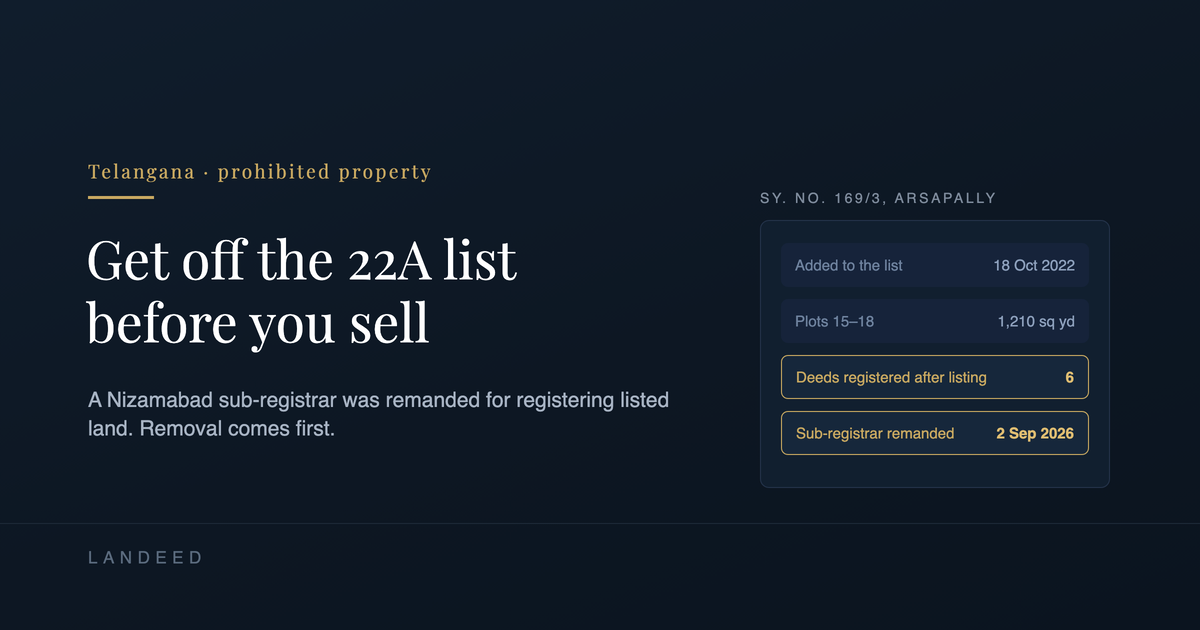
Until this week, an entry on the 22A list meant the registration office would refuse your sale deed, full stop. It did not matter that the layout had a sanctioned plan or that the building had a permit. The entry stood, and you were sent to the Collector to get it removed first.
The new orders carve out a lane for approved property. Open plots, houses and flats on the list can be registered if they carry a valid layout, building or apartment permission from GHMC, HMDA, DTCP, a municipality or another local body. You will need to show one registered document for the property dated after that permission was given. A committee in your district, headed by the Collector and including the District Registrar and someone from HMDA or your local body, looks at each case and clears the ones that qualify.
The government has said plainly that not every entry will be treated alike. Each case is judged on four things: what kind of land it is, what the records show, what permissions exist, and whether there is a legal matter attached to it. That last one is why the next section matters.
This is the government keeping a promise made in the Assembly on 16 September, when the Chief Minister said layouts already approved by HMDA, GHMC or DTCP but caught on the list would get their own scheme the following week.
Your entry on the list already tells you where you stand
Every property on the 22A list carries a short line saying why it is there, and a reference beside it. That line is the first thing the committee will read, so it should be the first thing you read.
We went through the plot and house entries on the list. More than half of them name the case outright: the court, the case number, the year. Most of the rest name the letter or the file number that put the property there, which points you at the office that raised it. Either way, you have a reference to walk in with, and you can find out where that matter stands before anyone asks you.
If your entry names a court matter, that is not a wall. A stay pauses registration while a case runs; it is not a ruling on your ownership. But the committee weighs legal issues alongside your permission, so walk in knowing what the case is and where it stands. If your entry names a memo or a file, your route is the straightforward one: permission, link document, committee.
Pulling your entry takes a few minutes. Search the prohibited list on the registration department's site by district, mandal and village, or open your Bhu Bharati record and read the transaction status line.
The three things to gather
The permission itself. The sanctioned layout plan from HMDA or DTCP, the building permit from GHMC or your municipality, or the apartment permission. If you bought from a developer or a society, they hold the original; ask for a copy with the proceedings number and the date on it.
One registered document dated after that permission. This is the link document the orders ask for. Any registration of the property after the approval qualifies. If you bought after the layout was sanctioned, your own sale deed does the job. If not, the developer's first sale in the layout, or the builder's agreement for the flat, is the one to fetch.
Your entry on the list. The reason line and the reference next to it. Take the reference with you; it tells the committee which file to open.
With those three, you are ready for the district committee. Without the middle one, you are not, so find it before you go.
If you would rather have the check done for you, Landeed's 22A Clearance service is ₹999. We look up your entry and tell you plainly what it says, help you gather the permission and the link document, and if your property qualifies under the new orders, help you take it to the committee.
What did Telangana's 24 September 2026 order on 22A properties allow?
Registration of open plots, houses and flats on the 22A list that hold a valid layout, building or apartment permission from GHMC, HMDA, DTCP, a municipality or another local body. A district committee headed by the Collector examines each case.
What is the link document the order asks for?
A registered document for the same property, such as a sale deed, dated after the permission was granted. The order asks for at least one.
Who examines my case?
A district-level committee headed by the Collector, with the additional collector, the District Registrar and a representative of HMDA or your municipal or rural local body.
What is the Section 22A prohibited property list?
The register of land the registration office must refuse to register documents for. An entry bars registration. It does not cancel your ownership.
Does the new route cover land under a court stay or assigned land?
The government has said each case is judged on the kind of land, the records, the permissions and any legal matter attached to it, and has not published a list of exclusions. Read the reason line on your entry, and if it names a court case, find out where that case stands before you apply.