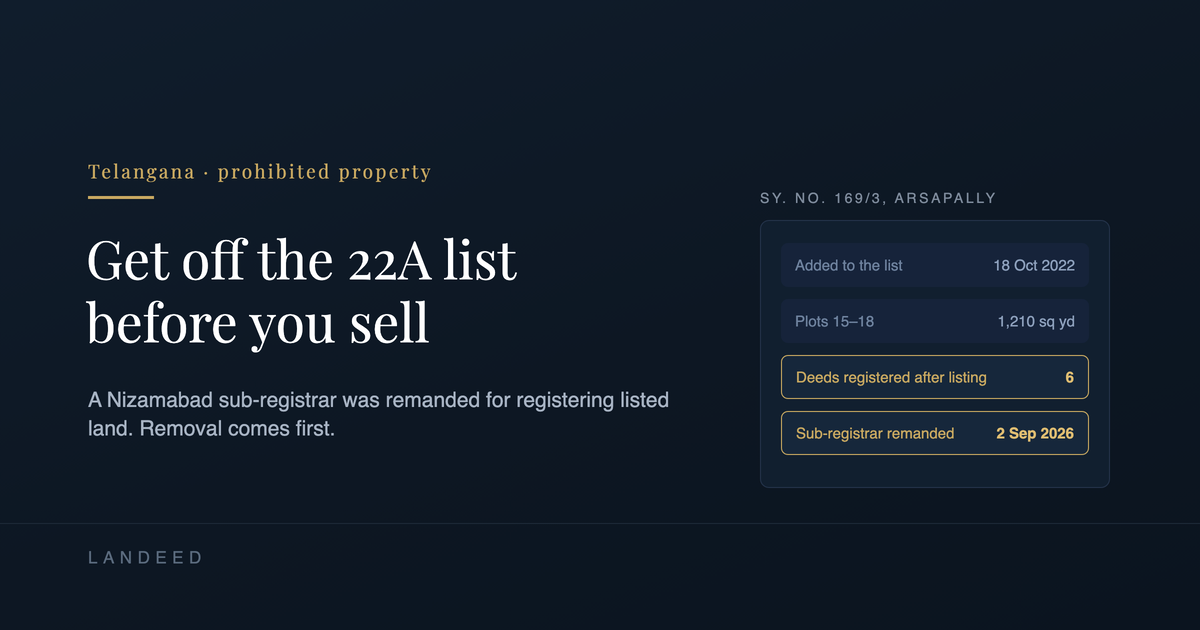
If you own land in Telangana, there is a list that decides whether you can sell it. It is called the Section 22A prohibited properties list, and it has been growing.
Land on this list cannot be registered. A Sub-Registrar is barred from accepting a sale, gift or mortgage deed against it. Your buyer's home loan will not be sanctioned. In most cases the owner finds out only at the registration counter, on the day of the deal.
What changed in 2026
In August 2025 the Telangana High Court, hearing petitions from owners who could not sell or mortgage their property, ordered that the 22A list must be made public rather than held internally.
Revenue officials then compiled a fresh 22A list. From December 2025 onwards, as land records moved from Dharani to the new Bhu Bharati system, owners began discovering their property had been added. The Revenue Minister has said 95,735 properties were included by mistake. A call centre was opened to handle complaints.
The state's own figures put the total at 98,02,544 acres under Section 22A, against roughly 84 lakh acres in February 2018.
New from 24 September: approved plots, houses and flats can be registered
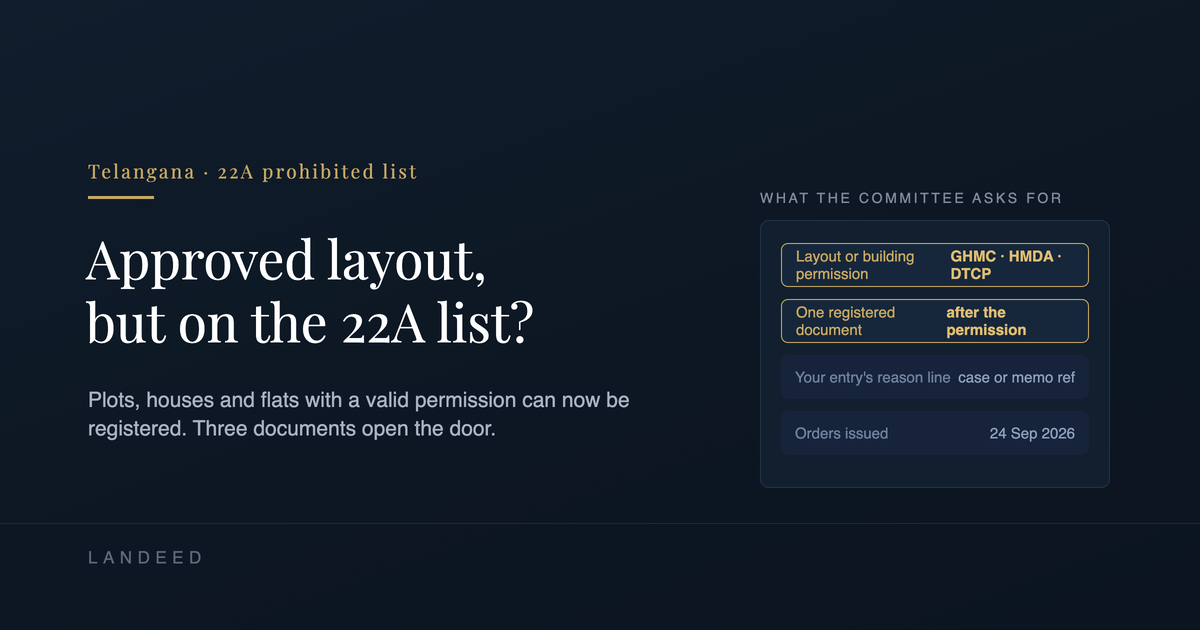
If your plot, house or flat is on the list but the layout or the building was approved by GHMC, HMDA, DTCP, a municipality or another local body, the Revenue Department's orders of 24 September 2026 let it be registered without waiting for the entry to be removed. You show the permission and one registered document for the property dated after that permission. A committee in your district, headed by the Collector and including the District Registrar and someone from HMDA or your local body, examines each case and clears the ones that qualify. Each case is judged on the kind of land, the records, the permissions and any court matter attached to it, so pull your own entry first and read the reason line beside it.
What Section 22A actually does
It bars registration, not ownership. This distinction matters and is widely misunderstood. Section 22A of the Registration Act, 1908 does not take your land away and does not make a sale illegal. It instructs the Sub-Registrar not to register the transaction. You remain the owner on paper; you simply cannot transfer it through the registration system while the entry stands.
Section 22A was added to the Act by an Andhra Pradesh amendment in 1999. The original wording barred anything "prohibited by public policy" — struck down by the Andhra Pradesh High Court in 2005 as too vague. A 2007 amendment replaced it with defined categories, and that version carried over to Telangana in 2014. Broadly, they cover:
- Land whose transfer is barred by some other law — this includes assigned land
- Government land
- Endowment and Wakf property
- Surplus land above the ceiling limit
- Other land prohibited by specific government order
The last category is the loose one. It is meant to require a detailed report from the District Collector and a public notification before land is added.
How to check your survey number
Two official routes, both free:
- The registration department list — registration.telangana.gov.in publishes prohibited property lists by district, mandal and village. You will need your survey number and village.
- Your Bhu Bharati record — pull up your own land record. If the parcel is flagged, the transaction status line will say the survey number is marked prohibited for transaction.
Do this before you pay an advance, not after. The check costs nothing and takes minutes.
What we found in the data
We looked at 22.2 million live Bhu Bharati parcel-owner records on 28 August 2026. Two things stood out.
First, the owner-facing record shows only a fraction of the register. Just under 4.7 lakh parcels — about 5.23 lakh acres — carry an explicit "marked prohibited for transaction" flag. That is a small share of the 98 lakh acres the state counts. Most of the difference is land with no private owner at all: forest, roads, tanks and government land account for roughly 72.7 lakh acres, and none of that has an owner record to flag.
Second, and more useful to you: assigned land almost never says "prohibited".
| What your Bhu Bharati record says | Parcels |
|---|
| Marked as Assigned Lands | 20,06,990 |
| Court stay or injunction | 1,832 |
| Marked as Government Land | 1,103 |
| Blocked for transaction | 538 |
Assigned land — land the government granted to a beneficiary — is prohibited under Section 22A(1)(a), and the state's own break-up counts 24,63,930 acres of it. But of the 20,23,660 assigned-land parcels we can see, covering about 19,95,550 acres, not one displays the prohibited flag. They show "marked as Assigned Lands" instead.
Those owners are warned that something restricts their land. What the record does not tell them is that it sits on the Section 22A register, which sub-section applies, or that a removal route exists. The reason is mundane: the transaction status is a single line of text, so only one message can be shown, and the assigned-land message wins.
The practical takeaway: if your record says "Assigned Lands", treat it as a registration bar. Do not assume that the absence of the word "prohibited" means you are clear.
Where it is most common
Across Telangana, about 2.1% of live parcels carry the prohibited flag. It is far from evenly spread.
| District | Flagged parcels | Share of parcels |
|---|
| Medchal-Malkajigiri | 18,495 | 7.70% |
| Bhadradri Kothagudem | 25,378 | 7.44% |
| Rangareddy | 53,304 | 3.86% |
| Sangareddy | 36,549 | 3.16% |
| Mulug | 5,990 | 2.90% |
| Kumuram Bheem Asifabad | 6,388 | 2.48% |
| Yadadri Bhuvanagiri | 24,151 | 2.27% |
Rangareddy has the most flagged parcels in absolute terms. But the highest rates are in Medchal-Malkajigiri, on Hyderabad's northern edge, and in Bhadradri Kothagudem — an agency district where tribal land protections apply. Mulug and Kumuram Bheem Asifabad are in the same position. The 22A problem is not only a city-fringe story.
One caveat worth stating: Bhu Bharati is an agricultural land record, so Hyderabad district barely appears in it. Its absence from this table is not evidence that urban Hyderabad is unaffected.
How to get an entry removed
If your property is not covered by the 24 September route above, or you want the entry itself removed, there is a defined route. On the Bhu Bharati portal, the TM 15 module handles applications to the Collector for grievances relating to land in the prohibited property list.
People are using it. Applications contesting a prohibited listing went from double digits in 2022 and 2023 to 489 in 2024 and 4,098 in 2025 — an eightfold jump in a single year, matching the period when the new list was compiled. The state says 23,136 acres have been taken off the list since 2023-24.
Practical notes before you apply:
- Get the exact reason and sub-section for the entry first. The document you need to rebut differs completely between a court attachment and an assigned-land entry.
- Collect your chain of title — sale deeds, pattadar passbook, older records showing the land as patta.
- Some entries carry a stale portal reference. We found 4,308 parcels whose on-screen instruction still points to Dharani, the system Bhu Bharati replaced. If yours does, use Bhu Bharati regardless.
If you would rather have help
Landeed runs a 22A Clearance Consultation for Telangana. It is ₹999, and it is three things:
- We check whether your survey number is on the list — and if it is, which category it sits under and which order put it there.
- We help with the documents. You get the exact checklist for your case, and where old records like the Sethwar, Khasra Pahani or link documents are missing, we fetch them.
- If your land is eligible, we help get it cleared. We prepare the grievance, guide it through the government process, and follow it until the entry is off the registration department’s list — not just an NOC from the Collector, which a sub-registrar can still refuse a deed on.
The decision rests with the District Collector under a defined government process, so nobody can promise an outcome or a date, and we will not. What we do promise is a straight answer: our expert reads your entry and tells you whether your case is eligible and exactly what it will take, before you commit to anything further. Share your survey number and village and you hear back within one business day.
If you are buying
Run the prohibited check as a separate step. An Encumbrance Certificate will not catch this — an EC lists transactions already registered against a property, while the 22A list is a bar on future registration. A clean EC and a 22A entry can coexist on the same survey number.
Check the exact survey number and sub-division you are buying, not just the parent number, and re-check close to registration. Entries are added and removed continuously.
And if the seller's record says "Assigned Lands", stop and get the position clarified in writing before any money moves.
How do I check if my land is on the Telangana 22A prohibited list?
Two free official routes. registration.telangana.gov.in publishes prohibited property lists by district, mandal and village. Your Bhu Bharati land record also carries a transaction status line that states when a survey number is marked prohibited for transaction.
Does Section 22A mean I no longer own my land?
No. Section 22A bars the Sub-Registrar from registering a sale, gift or mortgage deed against the property. It does not cancel your ownership. You remain the owner on paper but cannot transfer it through registration while the entry stands.
My Bhu Bharati record says Assigned Lands, not prohibited. Am I clear?
No. Assigned land is prohibited under Section 22A(1)(a). The transaction status is a single line of text, so a parcel that is both assigned and prohibited usually shows only the assigned-land message. Treat it as a registration bar.
How do I get my land removed from the prohibited list?
Apply to the District Collector through the TM 15 module on the Bhu Bharati portal, the application for a grievance relating to land in the prohibited property list. Establish the exact reason and sub-section first, because the evidence needed differs by category.
Will an Encumbrance Certificate show a prohibited entry?
No. An EC lists transactions already registered against a property, while the 22A list bars future registration. A clean EC and a live 22A entry can exist on the same survey number, so run both checks.