List of Unauthorised Colonies in Delhi by DDA
Quick answer: Delhi's Urban Development Department publishes an official List of 1,731 Unauthorised Colonies (excluding affluent UCs). To check a colony, search the PDF for its name, block and extension. Being on the list means the colony is formally identified, not that your plot has a clean title. Regularisation and ownership rights run through the PM-UDAY scheme, which DDA administers.
Last updated: 4 November 2026. Source: Urban Development Department, Government of NCT of Delhi.
Key facts about the Delhi unauthorised colonies list
- Total colonies: 1,731 (serial numbers 1 to 1,731).
- Scope: excludes colonies classed as "affluent UCs".
- Format: a 48-page PDF table with serial number, registration number, part and colony name.
- Publisher: Urban Development Department, Government of NCT of Delhi.
- Ownership route: PM-UDAY, administered through DDA's portal.
Introduction
If you are looking at a flat, plot or builder floor in Delhi, there is a fair chance it sits in an unauthorised colony. These are neighbourhoods that came up without formal approval of layout plans, yet are home to lakhs of families. The official list of unauthorised colonies in Delhi is the starting point for anyone who wants to check where a locality stands.
This guide explains what the list contains, how to check if your colony is on it, which parts of Delhi it covers most, and what to verify before you pay a rupee.
What is an unauthorised colony in Delhi?
An unauthorised colony is a residential area developed on land where the layout, plot sizes or construction were not approved by the competent authority. Many were built on agricultural or village land that was sub-divided and sold through agreements, power of attorney, will or similar papers rather than registered sale deeds from a sanctioned layout.
"Unauthorised" does not mean illegal to live in, and it does not mean there are no records. It means the colony lacks the formal approvals that a planned colony has. That is why title checks matter so much here. For a deeper look at one common paper trail, read our guide on getting clear legal title through power of attorney in Delhi's unauthorised colonies.
What does the official list of 1,731 unauthorised colonies contain?
The document is titled "List of 1731 Unauthorised Colonies (excluding affluent UCs)" and is hosted by the Delhi Urban Development Department. It is laid out as a simple table:
| Column | What it tells you |
|---|
| Serial number | Running count from 1 to 1,731. |
| Registration number | The number under which the colony is recorded. Some carry a suffix such as ELD or LOP. |
| Part | Shown where a colony is split into parts, for example entries marked A and B. |
| Name of colony | Colony name with locality, block or village, and often an area code such as "Delhi-41". |
The title says "excluding affluent UCs", so colonies classed as affluent are listed separately and are not part of these 1,731.
How to check if your colony is on the Delhi unauthorised colonies list
- Open the official PDF and use the search function for the main colony name.
- Search again for the block, extension or part, such as "Extn.", "A-Block" or "Part-II". Large colonies often appear several times.
- Try spelling variants, since names are written inconsistently (for example, Prem Nagar-II or Premnagar).
- Note the serial number and registration number, and quote them in any discussion with a lawyer or bank.
Examples of colonies on the list
Here are some entries as they appear in the list:
- Sangam Vihar, A-Block, New Delhi-62
- Noor Nagar Extn., Jamia Nagar
- Shastri Park Extn. (Buland Masjid), Delhi-53
- Mange Ram Park, Pooth Kalan, Sector-23, Rohini
- Najafgarh Park Colony, Blocks A, B and C, Dichaon Road
- Prem Nagar-II (several blocks), Kirari Suleman Nagar, Nangloi
Which areas of Delhi have the most unauthorised colonies?
Going by the place names in the entries, outer and south-west Delhi dominate. A rough count of mentions shows Najafgarh (around 250), Nangloi (around 150) and Uttam Nagar (over 120) appearing most often, followed by Badarpur, Mohan Garden, Burari, Sangam Vihar, Palam, Karawal and Kirari. Names ending in "Extn." and village "Lal Dora" or "Abadi" areas are also common. These counts are approximations based on place names in the text, not an official breakup by district.
Why the list matters for buyers
- It tells you whether a colony is recognised. If the colony name is on the list, it is among those the government has formally identified.
- It links to regularisation. The Centre's PM-UDAY scheme is the route through which residents can get ownership rights registered, and DDA runs the application process through its PM-UDAY portal.
- It affects loans, registration and resale. Banks and buyers ask different questions for properties in unauthorised colonies, so knowing the status early saves time.
Being on the list is not the same as having a clean title for your specific plot or flat. Rules, deadlines and procedures under PM-UDAY have been updated over time, so always check DDA's current notices before you act.
Checklist before buying property in an unauthorised colony
- Confirm the colony name and block against the official list, including any extension or part.
- Check the chain of ownership. Ask for every document that moved the property from the original landowner to the seller.
- Verify the type of papers. Is it a registered sale or conveyance deed, or only GPA, agreement to sell, will and possession letter? Our Delhi sale deed guide explains what a proper deed looks like.
- Look at the land record and encumbrance history for loans, mortgages or disputes. You can search for property records in Delhi to start.
- Check mutation status. See our Delhi mutation certificate guide.
- Check for litigation involving the seller or the land.
- Inspect the site and the construction. Match plot size, height and floors with the papers.
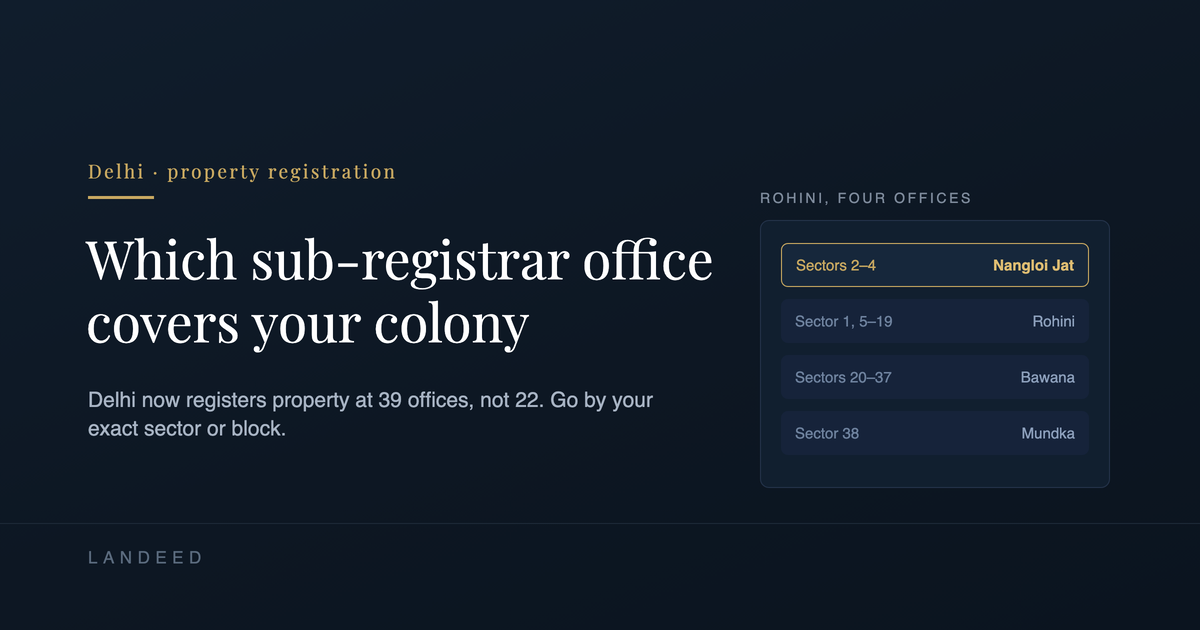
- Know your registration office. Find which of the 39 offices covers your colony in our Delhi sub-registrar offices guide.
- Pay only against documents and keep payments traceable.
- Get a legal opinion from a property lawyer before signing.
Conclusion
The Delhi list of 1,731 unauthorised colonies is a useful first filter, but it is only a filter. Use it to confirm the colony, then do the real work on your specific property: documents, ownership chain, encumbrances and legal opinion. A little diligence up front is far cheaper than a dispute later.
Source
List of 1731 Unauthorised Colonies (excluding affluent UCs), Urban Development Department, Government of NCT of Delhi: udd.delhi.gov.in. PM-UDAY information: Delhi Development Authority. This article is for general information and is not legal advice.
What is the list of unauthorised colonies in Delhi?
It is an official Delhi Urban Development Department list naming 1,731 unauthorised colonies, excluding those classed as affluent. Each entry has a serial number, registration number, part (if any) and colony name.
Is it safe to buy property in an unauthorised colony in Delhi?
It can be done, but it carries extra risk. Verify the chain of title, the type of documents, encumbrances and litigation, and take a legal opinion before paying.
How do I check if my colony is on the list?
Open the official PDF and search for the colony name, block and extension. Large colonies often appear several times, so check every variant.
What is PM-UDAY?
PM-UDAY is the central scheme for giving ownership rights to residents of unauthorised colonies in Delhi. DDA runs the registration process through its PM-UDAY portal. Check DDA's current notices for the latest rules.
Does being on the list mean my plot has a clean title?
No. The list recognises the colony, not the title of an individual plot or flat. Always verify your own property documents.