Quick answer: A General Power of Attorney (GPA) does not make you the owner of a property in Delhi. To get legal title in an unauthorised colony, you need a registered conveyance deed. If your colony is covered by the PM-UDAY scheme, you can apply on DDA's online portal with your GPA and related papers, and DDA issues a conveyance deed or authorisation slip that you then register at the Sub-Registrar's office. If your colony is not covered, the usual route is a registered sale deed from the legal owner or their heirs.
Last updated: 4 November 2026. This article is for general information and is not legal advice.
Key facts at a glance
- Why convert: a GPA, agreement to sell or will does not by itself transfer ownership of immovable property.
- Main route for unauthorised colonies: PM-UDAY, applied for online through DDA's portal.
- Title document issued: a conveyance deed (government land) or an authorisation slip (private land), for residential use.
- Final step: registration of that document at the Sub-Registrar's office.
- Papers accepted: DDA's FAQs state that unregistered documents are accepted as supporting papers.
Why a GPA is not enough in a Delhi unauthorised colony
In many unauthorised colonies, plots were sold through a set of papers: a General Power of Attorney, an agreement to sell, an affidavit, a will and a receipt. Buyers paid in full and took possession, so it felt like a purchase. Legally, it is not.
In Suraj Lamp & Industries Pvt. Ltd. v. State of Haryana (2011), the Supreme Court held that sales through GPA, agreement to sell and will do not convey title, and that immovable property can be transferred only by a registered deed. Existing GPA-based holdings were not wiped out, but they do not give you the full, marketable title that a registered deed does. That affects bank loans, resale, inheritance and disputes.
For more on how these paper trails work in practice, read our guide on getting clear legal title through power of attorney in Delhi's unauthorised colonies.
What is a conveyance deed?
A conveyance deed is a registered document that transfers ownership of property from one party to another. For a buyer, it is the paper that establishes title. In the PM-UDAY scheme, DDA's FAQs describe the title document as a conveyance deed where the land is government land and an authorisation slip where the land is private. Both are registered with the Sub-Registrar.
Two routes to convert GPA property to a conveyance deed
| Route | Best for | How it works |
|---|
| PM-UDAY (DDA) | Residential property in a colony covered by the scheme | Apply online with your GPA, agreement to sell, payment and possession documents, site plan and GPS data. DDA verifies, inspects, issues the title document, and you register it. |
| Registered sale deed | Property outside PM-UDAY, or where a direct sale from the owner is possible | The legal owner (or legal heirs) executes a sale deed in your favour, with stamp duty paid and registration at the Sub-Registrar's office. |
Route 1: Convert GPA property under PM-UDAY
PM-UDAY (Pradhan Mantri Unauthorised Colonies in Delhi Awas Adhikar Yojana) gives residents of eligible unauthorised colonies a way to get ownership rights. Based on DDA's FAQs, the process works like this.
Step 1: Check whether your colony is covered
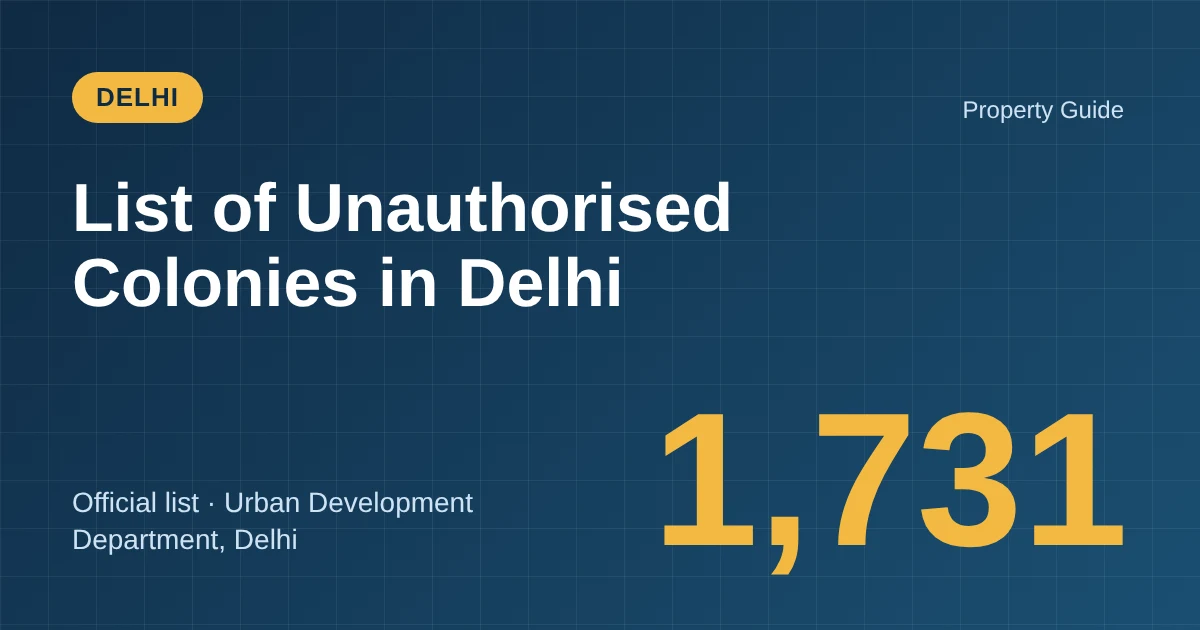
DDA's FAQs say the regulations notified on 29 October 2019 cover colonies existing as on 1 June 2014 with at least 50% built-up area as on 1 January 2015. They also exclude certain categories, including affluent colonies, colonies regularised in 1977, and areas such as reserved forest, the Yamuna flood plain and the ridge. Start by checking your colony against the official list of 1,731 unauthorised colonies in Delhi, then confirm eligibility on DDA's portal.
Step 2: Gather your documents
The application asks for supporting papers such as your General Power of Attorney, agreement to sell, payment and possession documents, a site plan and GPS data. DDA's FAQs state that unregistered documents are accepted. Also keep ID proof, any earlier sale papers in the chain, property tax or utility bills, and photographs of the property.
Step 3: Apply online on DDA's PM-UDAY portal
Applications are made only through DDA's online system. Fill in the details carefully and upload the documents. Mismatches between names, plot numbers or dates are a common reason for queries.
Step 4: Document verification and physical inspection
DDA officials check your documents on the portal and carry out a physical verification of the property. Be ready to show possession and, if asked, access to the site.
Step 5: Receive the title document
After scrutiny, DDA issues the title document: a conveyance deed for government land or an authorisation slip for private land. This is for residential use. If you already hold a registered sale deed, DDA's FAQs say you also apply, and DDA issues an authorisation slip after scrutiny.
Step 6: Register it at the Sub-Registrar's office
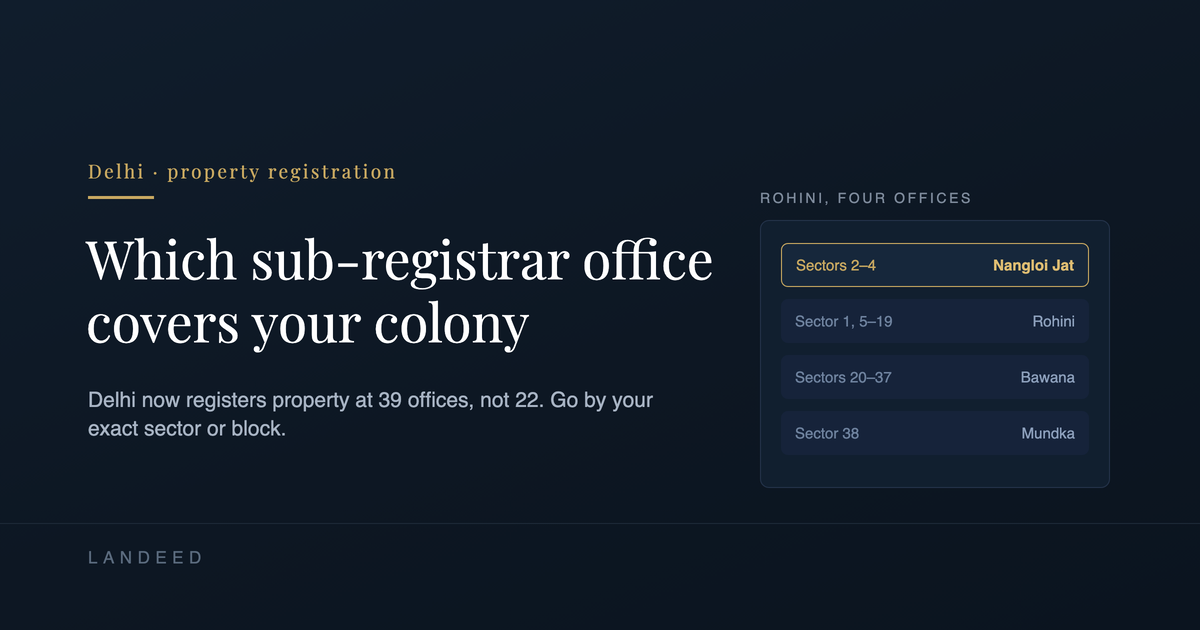
Take the title document to the Sub-Registrar's office for registration and pay the stamp duty and registration charges. DDA's FAQs describe these charges as nominal, but rates and rules change, so confirm the current figures before you go. Not sure which office covers your colony? See our guide to Delhi sub-registrar offices.
Step 7: Apply for mutation
Once registered, update the municipal records in your name. Our Delhi mutation certificate guide walks through the process.
Route 2: Get a registered sale deed from the legal owner
If your colony is not covered by PM-UDAY, or you want a direct registered sale, the route is a sale deed executed by the legal owner in your favour.
- Trace the legal owner. Identify the person who granted the GPA, or the current owner on record. Confirm they are alive and willing to sign.
- If the owner has died, remember that a power of attorney generally ends with the death of the person who granted it. The legal heirs may need to execute the deed, and you will need proof of their legal heirship.
- Verify the title chain. Check for earlier sales, mortgages, court cases and dues. You can search for property records in Delhi as a starting point.
- Draft the sale deed. A property lawyer should prepare it, with correct plot details, boundaries and consideration.
- Pay stamp duty and registration charges. These are generally calculated on the circle rate or the consideration, whichever is higher. Check current rates, including any concessions, with the Delhi Revenue Department.
- Register at the Sub-Registrar's office. Both parties and witnesses attend with ID proof and the original documents. Our Delhi sale deed guide explains what a proper deed contains.
- Apply for mutation after registration.
Documents checklist
- Original General Power of Attorney
- Agreement to sell, receipts and proof of payment
- Affidavit and will, if part of your chain
- Earlier sale deeds or title documents in the chain
- Proof of possession such as bills and tax receipts
- Site plan and GPS data, where required by DDA
- ID proof, address proof and photographs of the parties
- Legal heirship documents, if the original owner has died
What the 2026 Delhi GPA rules mean for you
In July 2026, reports said the Delhi government had tightened how GPAs are registered, to curb stamp duty evasion and fraud. As reported, GPAs given to anyone other than close blood relatives are referred to the Collector of Stamps, who decides whether the document is an ordinary GPA or in effect a conveyance that attracts full stamp duty. Sub-Registrars are also to look closely for clauses involving monetary consideration, transfer of ownership, irrevocable powers or permanent rights to sell or mortgage.
These changes mainly concern the registration of GPAs. If your GPA is an older document that you are now converting into a title deed, the practical lesson is the same: a GPA that reads like a sale is a sign you need a proper conveyance deed. Ask a property lawyer how the current rules apply to your papers.
Common mistakes to avoid
- Treating a GPA as ownership. It is not, and it can fail if the owner dies or revokes it.
- Skipping eligibility checks. Not every colony or property is covered by PM-UDAY.
- Paying again without checking. Confirm who the legal owner is before any new payment.
- Ignoring the chain of documents. A gap in the chain can stall the application.
- Not registering the final document. The title document must be registered with the Sub-Registrar.
- Not mutating the property. Update municipal records after registration.
Conclusion
If you hold a property in a Delhi unauthorised colony through a GPA, converting it into a registered conveyance deed is the step that turns a paper trail into legal title. Check whether PM-UDAY covers your colony, assemble your documents, and follow the process through to registration and mutation. If your property sits outside the scheme, work with a property lawyer on a registered sale deed from the legal owner or their heirs.
Sources
PM-UDAY Frequently Asked Questions, Delhi Development Authority. Supreme Court of India, Suraj Lamp & Industries Pvt. Ltd. v. State of Haryana (2011). News reports on the July 2026 Delhi GPA registration measures. This article is for general information and is not legal advice.
Does a General Power of Attorney make me the owner of property in Delhi?
No. Since the Supreme Court's 2011 Suraj Lamp & Industries judgment, a GPA, agreement to sell or will does not by itself transfer ownership of immovable property. Title passes only through a registered conveyance deed or sale deed.
How do I convert a GPA property to a conveyance deed in a Delhi unauthorised colony?
If your colony is covered by PM-UDAY, apply on DDA's online portal with your GPA, agreement to sell, payment and possession documents, site plan and GPS data. After verification and a physical inspection, DDA issues a conveyance deed or authorisation slip, which you register at the Sub-Registrar's office. If your colony is not covered, you generally need a registered sale deed from the legal owner or their heirs.
Can unregistered GPA or agreement to sell documents be used under PM-UDAY?
Yes. DDA's PM-UDAY FAQs state that unregistered documents are accepted as supporting papers for the application. Rules can change, so check DDA's current notices before you apply.
What happens to a GPA if the original owner dies?
In general, a power of attorney ends when the person who granted it dies, unless it is coupled with an interest. This is another reason a GPA is a weak basis for ownership, and why legal heirs may need to be involved in a sale deed.
Do the 2026 GPA registration rules in Delhi affect my conversion?
Reports from July 2026 say Delhi has tightened registration of GPAs, including referral to the Collector of Stamps in certain cases and closer checks for sale-like clauses. These changes mainly target registering GPAs. Ask a property lawyer how they apply to your papers.