We Asked ChatGPT, Gemini, and Terra the Same Property Question. One of Them Actually Solved It
The others told us what to check. Terra checked it.
By Landeed · 5 min read · Indian Real Estate
HOW THIS STARTED
Imagine you've finally found a flat you like. Now what?
Three months of searching. Weekends spent in traffic, walking through apartments that looked better in photos. And then, finally, one that feels right. 2BHK, decent location, fair price. The seller wants a token advance by the weekend.
Before you transfer anything, you have two questions. How much loan can I actually afford? And is this property actually clean?
We asked all three: ChatGPT, Gemini, and Terra. Same prompts, same property, no editing the responses to look better or worse. Here's what happened.
ROUND 1: THE MONEY QUESTION
How much loan can you actually afford?
Before evaluating any property, you need a number you can live with. Not what the bank approves. Banks will approve more than you should borrow. You need the number that won't leave you eating instant noodles by the 25th of every month.
The prompt we gave all three:
Act as a financial expert using first-principles thinking. Salary: ₹7–9 LPA, interest rate: 7.10%. Calculate my ideal home loan and EMI, based on what I need to survive comfortably without becoming house-poor. Break down the math and explain the hidden costs of homeownership.
01 ChatGPT
Straight to the numbers. No fluff.
ChatGPT came back quickly and cleanly. It applied the 30% rule: your EMI shouldn't cross 30% of take-home pay, regardless of what the bank says. It worked backwards to a loan range of ₹18–25 lakh for a ₹7–9 LPA salary at 7.10% interest. It didn't stop at the EMI either. It called out the hidden costs most buyers forget: stamp duty, registration, society maintenance, annual repairs, and the opportunity cost of locking your down payment away from the market.
One line stuck with us: "Banks don't care if you eat dal-chawal every night." That's not GPT being clever. That's GPT being right.
Its honest conclusion: at ₹8 LPA, a ₹60–70 lakh flat is a stretch. It suggested either waiting two to three years to grow income, or buying smaller now and avoiding the financial squeeze.
02 Gemini
Same math, sharper framing.
Gemini arrived at similar numbers. ₹20–25 lakh loan, EMI capped at 30%. But framed it differently. It talked about financial fragility: if you start at 50% EMI-to-income and rates rise even a little, you cross into crisis territory fast. It introduced the concept of resilience, not just affordability.
It also flagged something the others touched on but didn't dwell on: the opportunity cost of the down payment. ₹10 lakh sitting in a flat isn't working for you. At 12% market returns, that's ₹1.2 lakh a year in gains you're giving up. Whether that's a reason to rent or just a reason to be aware, it's the kind of thing most property advisors never mention.
Solid, honest, and slightly more conservative than ChatGPT.
03 Terra
The math plus the next question.
Terra's financial response was in the same range: ₹18–24 lakh loan, 30% EMI rule, detailed breakdown of both one-time and recurring hidden costs. The numbers matched. The reasoning was equally sharp.
But then it did something the other two didn't. After giving the financial answer, it asked where we wanted to go next: "Will this property get a loan approved? Find properties in my budget. What documents will the bank ask for?"
ChatGPT and Gemini had answered the question and closed the conversation. Terra seemed to understand that knowing your loan limit is just the beginning. The next step is the property itself. So we followed that thread.
ROUND 2: THE REAL TEST
We gave all three a real property address.
Taking Terra's cue, we shared the actual flat under consideration: a specific unit in a residential complex in Kondapur, Hyderabad, Survey No. 112. We asked all three to check its ownership and encumbrance status before we paid the token advance.
This is where things got genuinely interesting.
The prompt we gave all three:
Check the ownership and encumbrance status of [a specific flat in a residential complex, Survey No. 112, Kondapur, Hyderabad, Telangana].
01 ChatGPT
Six minutes of thinking. One finding that mattered.
ChatGPT took six minutes before responding. When it came back, it had found something real: a live 2026 Telangana High Court case involving Kondapur lands, specifically Survey No. 112/3, with competing claims over title, mutations, and construction activity. It couldn’t confirm whether our specific flat fell under that sub-division. But it said clearly: that’s not a reason for comfort, it’s a reason for caution.
Its verdict was unambiguous. Ownership: unverified. Encumbrance: unverified. Buyer risk: amber. Do not pay a non-refundable token yet.
It also noted that Telangana’s Prohibited Properties portal was under review at the time and couldn’t be relied on for a clearance signal. Then it laid out a precise document checklist: sale deed, EC from 1983 to present, title chain, OC, bank NOC, property tax receipts. It offered to analyse them if we uploaded the files.
02 Gemini
A precise guide to doing it yourself.
Gemini was upfront: it can’t access live government databases. But it didn’t stop there. It gave us the most detailed step-by-step guide to running the EC search ourselves on the IGRS Telangana portal: which district, which mandal, which search method to choose, what the PDF output will look like, and what “Nil Encumbrance” means when you see it.
It flagged the UDS (Undivided Share) issue common in Kondapur apartments, reminded us to check the Prohibited Properties list for Survey 112, and suggested asking a major bank like SBI or HDFC if they’ve technically cleared the building. If a bank won’t fund it, it said, that’s your answer.
Useful, thorough, and honest. You still had to make the journey yourself. But at least you knew exactly where to go.
03 Terra
It didn't guide us. It went in.
Terra didn't start with a disclaimer. It started with a search.
It cross-referenced the property's coordinates against live parcel data and caught something immediately: the building doesn't sit on Survey 112. The parcel data at that exact location shows Survey No. 84. Survey 112 is a large Kondapur parcel covering multiple projects, and the flat may fall under a sub-division, but the revenue survey at those coordinates is different from what we'd been given. Terra flagged it clearly: verify this against your sale deed before doing anything else.
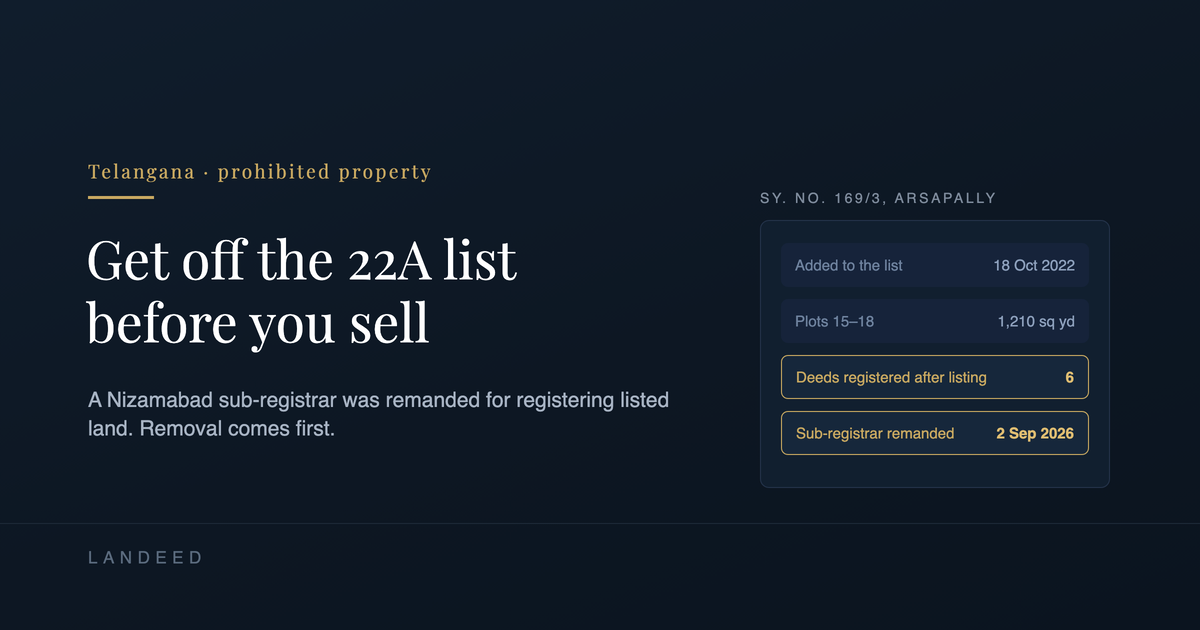
Then it pulled an actual Prohibited Property Report for Survey 112. Not a suggestion to go find one. An actual document. It explained why the EC search by survey returned empty (large urban parcels hold hundreds of transactions; door number is the precise search path for a flat), and told us exactly what it needed next: a door number or PTIN, after which it would fetch the EC and verify ownership through registration records.
No other AI got this far. Not because ChatGPT or Gemini aren't capable. They clearly are. But reading live parcel data and pulling prohibited property reports requires being connected to those systems. Terra is. The others aren't.
WHAT MAKES TERRA DIFFERENT
It's not about which AI is smarter. It's about what each one can reach.
ChatGPT and Gemini both brought something real to this experiment. Gemini gave us the clearest guidance on navigating the verification process ourselves. ChatGPT found a live court case that most buyers would never think to search for. The kind of thing that could prevent a catastrophic purchase.
But neither of them could cross into the actual systems. They could describe what an Encumbrance Certificate says. They couldn't pull one. They could tell us to check the Prohibited Properties list. They couldn't fetch the report.
Terra caught a survey number discrepancy by checking live parcel data. It pulled an actual document. It had the next action ready. That's not a better answer. That's a different category of capability.
Gemini told us what to check.ChatGPT told us what might be wrong.Terra started checking.
BOTTOM LINE
You can't use one AI for everything. Now you know which to use when.
For understanding your finances: loan math, EMI limits, hidden costs. All three are excellent. Pick whichever you're comfortable with.
For background research on a property: legal risks, document checklists, what to watch out for in a specific area. ChatGPT and Gemini are genuinely strong. Don't underestimate them.
For verifying a specific property before you pay: pulling records, catching discrepancies, checking what's actually in the land registry. You need a tool that's connected to those systems. General-purpose AI isn't. Terra is.
At some point, the conversation has to become an action. Know which tool takes you there.
Try Terra
Verify property ownership, encumbrance certificates, and mutation records instantly with Landeed ,across states, in seconds. landeed.com