Every apartment purchase in Hyderabad comes with government charges on top of the base price. Stamp duty, transfer duty, registration fees, and GST add 7.5% to ~10.8% to your total cost depending on whether you're buying under-construction or ready-to-move.
This guide covers what you'll pay, when you'll pay it, and how to estimate your total outflow.
Key Takeaways
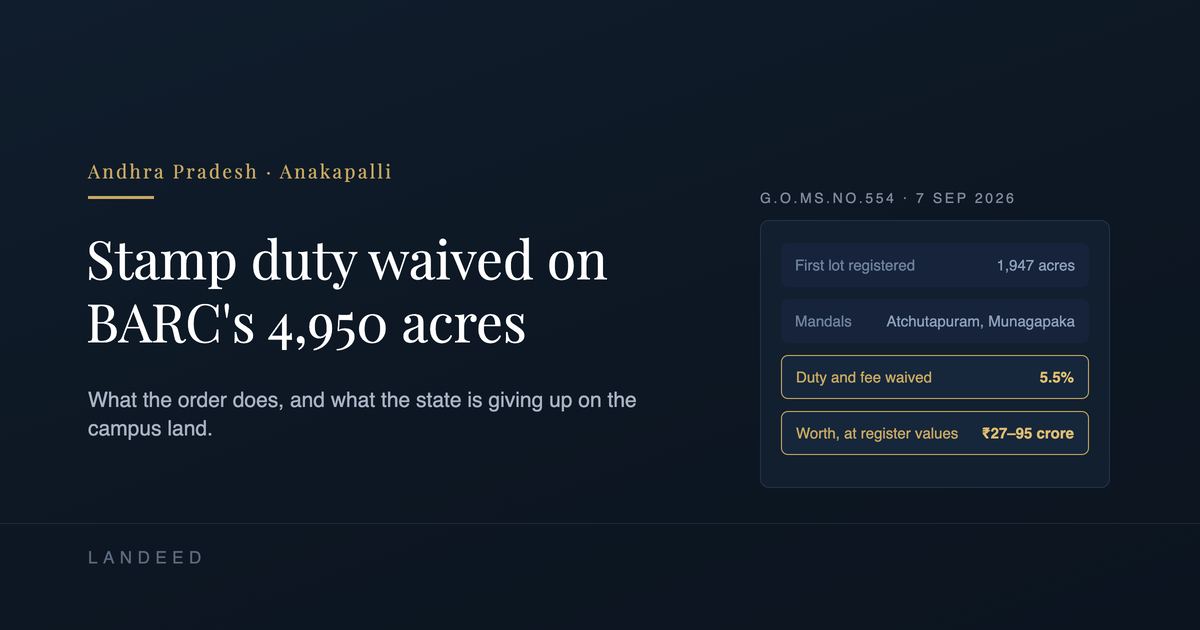
- Registration charges in Hyderabad: 7.5% (stamp duty 5.5% + transfer duty 1.5% + registration 0.5%)
- Under-construction apartments: add ~3.33% effective GST (5% applied on construction value, not total price)
- Ready-to-move with OC: 0% GST — you pay only 7.5%
- Affordable housing under-construction: ~0.67% effective GST (1% on construction value, carpet area limits apply)
- Charges are calculated on market value or agreement value, whichever is higher
- Gram Panchayat areas: same 7.5% total, different split (no transfer duty, 2% registration)
Calculate your exact charges →
What are the registration charges for apartments in Hyderabad?
When you buy an apartment in Hyderabad, you pay three charges to register the sale deed:
These rates apply to properties within GHMC limits, municipalities, and corporation areas.
Source: G.O.Ms.No.59, Revenue (Registration) Department, Government of Telangana, dated 20.07.2021
What's the difference between stamp duty, registration, and transfer duty?
Stamp Duty (5.5%)A tax on the sale deed document. Under the Indian Stamp Act, 1899, a document isn't legally valid unless stamped.
Registration Fee (0.5%)A fee for recording the transaction in government records at the Sub-Registrar office. This creates a searchable public record.
Transfer Duty (1.5%)A municipal levy on property transfers within corporation or municipality limits. Goes to GHMC or the local body, not the state.
How much GST applies to apartment purchases?
GST applies only to under-construction apartments. Once a project has its Occupancy Certificate, the sale is treated as immovable property — no GST.
GST is charged on the construction value, not the total price. The government assumes 1/3 of your agreement value is land (GST-exempt). So GST applies to the remaining 2/3.
GST is paid to the builder with your installments. Registration charges are paid separately at the Sub-Registrar office.
Note: Some builders charge GST on full agreement value. Verify your builder's invoice — legally, GST applies only to construction value (2/3 of total).
How do I calculate total charges on an ₹80 lakh apartment?
Scenario 1: Under-construction (₹80 lakh)
Registration charges (paid at Sub-Registrar):
GST (paid to builder):
Total charges: ₹8,66,667Total outflow: ₹88,66,667 for an ₹80 lakh apartment.
Scenario 2: Ready-to-move with OC (₹80 lakh)
Total outflow: ₹86,00,000 for an ₹80 lakh apartment.
Get exact figures for your property →
What is market value and how does it affect charges?
Stamp duty is calculated on market value or agreement value, whichever is higher.
Market value is the government's benchmark price for each locality. If you're buying at ₹80 lakh but the guideline value works out to ₹90 lakh, you pay stamp duty on ₹90 lakh.
The Registration Department publishes these rates. For built-up property, they use ₹1,100 per sq.ft for RCC structures in HMDA and corporation areas.
Check the market value before finalizing your purchase. You can verify on the Landeed Stamp Duty Calculator or the IGRS Telangana portal.
Source: G.O.Ms.No.58 dated 20.07.2021; C&IG Proceedings No. MV/539/2014 dated 20.07.2021
When do I pay these charges?
Registration happens at the Sub-Registrar office. Book a slot on the IGRS Telangana portal, pay via e-Stamp, and visit with your documents.
What documents do I need for registration?
Buyer documents:
- PAN card
- Aadhaar card
- Passport-size photographs
- Address proof
Property documents:
- Sale deed (drafted by builder/seller)
- Encumbrance Certificate (EC)
- Previous sale deeds (title chain)
- Latest property tax receipts
- Builder's approvals, NOC, and OC
- Approved building plan
- RERA registration (where applicable)
How are Gram Panchayat charges different?
If your property falls under a Gram Panchayat instead of GHMC or a municipality:
Same total, different split. Gram Panchayats don't have municipal bodies to collect transfer duty.
Quick reference
What should you verify before registration?
Before you commit to these numbers, check that the property's title is clean. An Encumbrance Certificate (EC) shows whether the property has any loans, mortgages, or legal disputes registered against it.
The EC covers the property's transaction history — typically 13 or 30 years. A clean EC means the title chain is clear and you're not inheriting someone else's liability.
You can get an EC from the Sub-Registrar's office, or download one instantly through Landeed without visiting any government office.
Sources
What are the stamp duty charges for apartment registration in Hyderabad 2026?
Stamp duty in Hyderabad is 6% of the property value for general buyers. Women buyers get a concession of 1%, paying only 5%. This applies to both ready and under-construction apartments.
What is the registration fee for flats in Hyderabad?
Registration fee in Hyderabad is 0.5% of the property value, subject to a minimum of Rs. 1,000 and maximum of Rs. 30,000. This is in addition to stamp duty and GST charges.
Is GST applicable on apartment purchase in Hyderabad?
GST applies only to under-construction properties at 5% without input tax credit (ITC) or 12% with ITC. Ready-to-move apartments with completion certificate are exempt from GST.
How is property value calculated for registration in Hyderabad?
Registration charges are calculated on the higher of sale consideration or government guideline value (circle rate). The Telangana Registration department maintains updated circle rates for all areas.
What documents are needed for apartment registration in Hyderabad?
Required documents include sale agreement, builder's documents (approvals, RERA certificate), identity proofs (Aadhaar, PAN), photographs, previous title documents, encumbrance certificate, and payment receipts.